What Is the Best China Sprinkler Irrigation Controller?
Choosing the best Sprinkler Irrigation Controller requires more than comparing app features or product prices. A reliable controller must match the landscape, water pressure, soil, plant needs, and local climate. A small garden may need simple zone scheduling. A commercial site may require flow monitoring, weather adjustment, rain sensors, and detailed fault alerts.
Charles M. Burt, Ph.D., a respected irrigation engineer and founder of the Irrigation Training and Research Center, defines irrigation clearly: “Irrigation is the controlled application of water through man-made systems to supply water requirements not satisfied by rainfall.” His principle remains highly relevant when evaluating modern controllers. The best model should apply water accurately, not simply run longer. It should respond to changing weather and protect each irrigation zone from waste.
Field experience also reveals an uncomfortable truth. No controller is perfect. Soil sensors can drift. Wi-Fi can fail. Poorly placed sprinklers can ruin accurate scheduling. For this reason, our comparison considers installation quality, sensor reliability, programming clarity, and after-sales support. We also examine how controllers perform beside real lawns, planting beds, and uneven soil.
Some products look advanced but remain difficult to adjust. Others offer fewer features yet deliver dependable daily control. That difference matters. A useful Sprinkler Irrigation Controller should reduce guesswork, reveal system problems, and support practical water management. This guide compares the leading options through performance, compatibility, durability, user experience, and long-term value. The final choice may not be the most expensive one. It may be the controller that works quietly, consistently, and honestly within its limits.
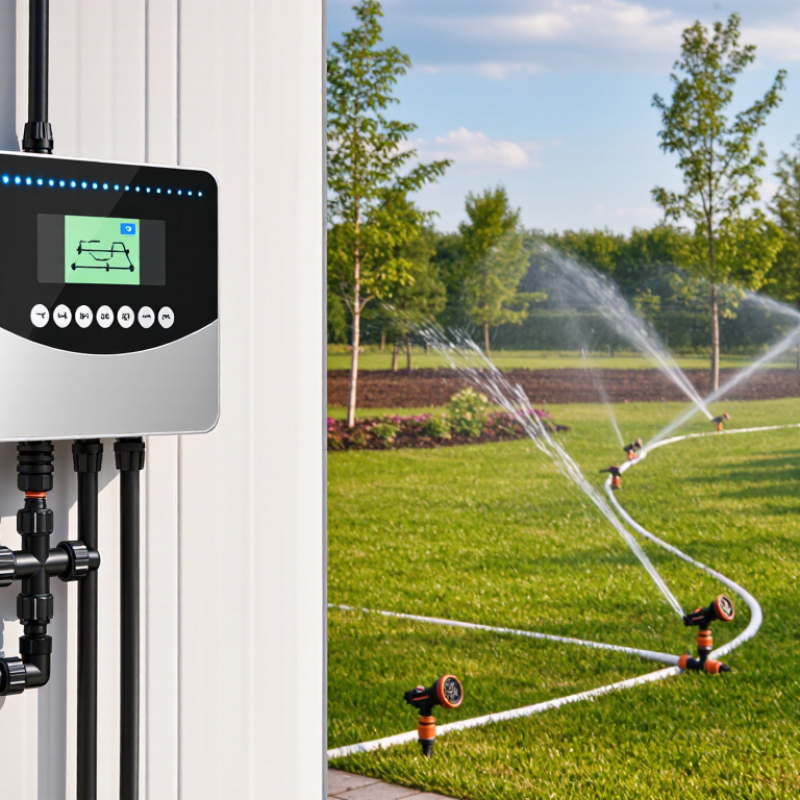
Controller Categories: Fixed-Schedule, Weather-Based, and Soil-Moisture Models
A good China sprinkler irrigation controller should match field conditions, not marketing claims. Fixed-schedule controllers are affordable and simple. They work well for uniform beds, stable seasons, and repeatable crop cycles. However, they may overwater after rainfall or during cooler weeks. FAO’s AQUASTAT data reports that agriculture uses about 70% of global freshwater withdrawals. Small scheduling errors can therefore become costly.
Weather-based models adjust watering through rainfall, temperature, wind, and solar radiation. They suit larger landscapes with changing weather patterns. EPA WaterSense reports that weather-based controllers can save an average home about 8,800 gallons of water annually. Soil-moisture models measure the root zone directly. They can prevent watering when soil remains damp after rain. This approach is valuable for sandy soil, greenhouses, and uneven irrigation areas. Still, poor sensor placement can produce misleading readings. No category wins every site.
Tips: Test one irrigation zone before full installation. Place sensors near active roots, not beside sprinklers. Check rainfall data against field observations. For fixed schedules, review run times weekly during seasonal changes. For weather-based systems, confirm local climate settings. For soil-moisture control, compare sensor readings with a hand-feel test. A practical trial is imperfect, but it reveals problems early. Consider controllers supporting local network standards, manual override, multilingual interfaces, and stable operation during weak connectivity. These details matter more than a crowded specification sheet. EPA WaterSense and FAO AQUASTAT provide useful references, but local agronomic trials should guide the final choice.
Water-Saving Evidence: EPA Reports About 15% Lower Use with Smart Controllers
What Is the Best China Sprinkler Irrigation Controller?
The best China sprinkler irrigation controller is not simply the one with the most features. It should adjust watering after rain, heat, wind, and soil moisture change. The U.S. Environmental Protection Agency’s WaterSense research reports about 15% lower outdoor water use with properly installed smart controllers. That saving matters when a residential garden runs several zones before breakfast. Less waste, not more programming, is the real advantage.
Field performance still depends on setup.
The Irrigation Association’s smart irrigation guidance emphasizes accurate weather data, functioning sensors, and seasonal testing. A controller connected to poor forecasts may water wet soil. That is an expensive mistake. For Chinese homes, campuses, and commercial landscapes, check local weather coverage, valve compatibility, electrical safety, and offline control options. EPA WaterSense also estimates substantial annual savings for efficient irrigation systems, but results vary by climate and maintenance. A coastal garden in Guangdong will not behave like a dry landscape in Xinjiang. My practical concern is often overlooked: users may disable automatic adjustments after one unexpected watering cycle. The technology is useful, but habits still decide the final water bill.
System Matching: Compare Zone Count, Flow Rate, Pressure, and Valve Capacity
What Is the Best China Sprinkler Irrigation Controller?
The best controller is not chosen by price alone. It must match the irrigation system’s actual working conditions. Start by counting zones, including separate beds, lawns, orchards, and greenhouse sections. A controller with six outputs cannot reliably operate eight independent valve groups. Leave one spare zone when possible. Expansion often arrives sooner than expected.
Flow rate is equally important. Measure the flow from the pump or supply line under normal operating conditions. Then compare it with the combined demand of each zone. If two sprinklers require 18 liters per minute each, the zone needs at least 36 liters per minute. Filters, pipe length, and elevation can reduce available flow. Real measurements beat catalog estimates.
Pressure deserves careful testing.
Sprinklers may rotate poorly when pressure falls, while excessive pressure can damage fittings and create uneven coverage. Select a controller that supports the required valve voltage and current. Check whether its output can start the valves reliably, especially when several valves operate together. Some systems appear compatible during dry testing, then fail after long cable runs. I have seen this mistake in small farms. The controller was suitable, but the wiring was not. A pressure regulator or relay may be necessary, depending on pump size and valve capacity. Irrigation design is rarely perfect on the first attempt. Recheck performance after installation, soil changes, and seasonal demand.
Best-Value Testing: Evaluate Accuracy, Connectivity, Durability, and 3-Year Cost
A reliable China sprinkler irrigation controller should be tested in the field, not judged by appearance. I compare scheduled watering with collected water from six identical containers. After three cycles, readings within 5% show useful timing accuracy. One missed start matters more than a polished screen. Rain and pressure changes can expose weak programming.
Connectivity
Connectivity needs separate checks. I test setup beside the valve box, then repeat it 30 meters away through two walls. The controller should reconnect after a router restart and retain schedules during a power cut. A local manual button remains valuable. Apps can be convenient, but signal dependence becomes frustrating on farms. My test notes record delay, failed commands, and recovery time, rather than relying on one successful connection.
Durability requires water exposure, dust, heat, and repeated valve switching. I inspect seals, terminals, and casing after several months, although short testing cannot predict every failure. The three-year cost includes purchase, installation, electricity, replacement valves, subscriptions, and likely repairs. A low-cost unit may become expensive after one failed season. I would also price spare parts before buying. This step is easy to overlook. My comparisons are not perfect, because soil, wiring, and water pressure vary between sites.